Achieving 10X Sensitivity in Nanoplasmonic Sensors
Pushing Hardware Beyond Its Physical Limits
In the pursuit of safer green energy infrastructure, engineers constantly attempt to build more sensitive hydrogen detectors. However, physical sensors eventually hit fundamental thermodynamic limits. In our 2024 Nature Communications paper, Neural network enabled nanoplasmonic hydrogen sensors with 10X sensitivity improvement, we demonstrated that AI can break through these physical ceilings.
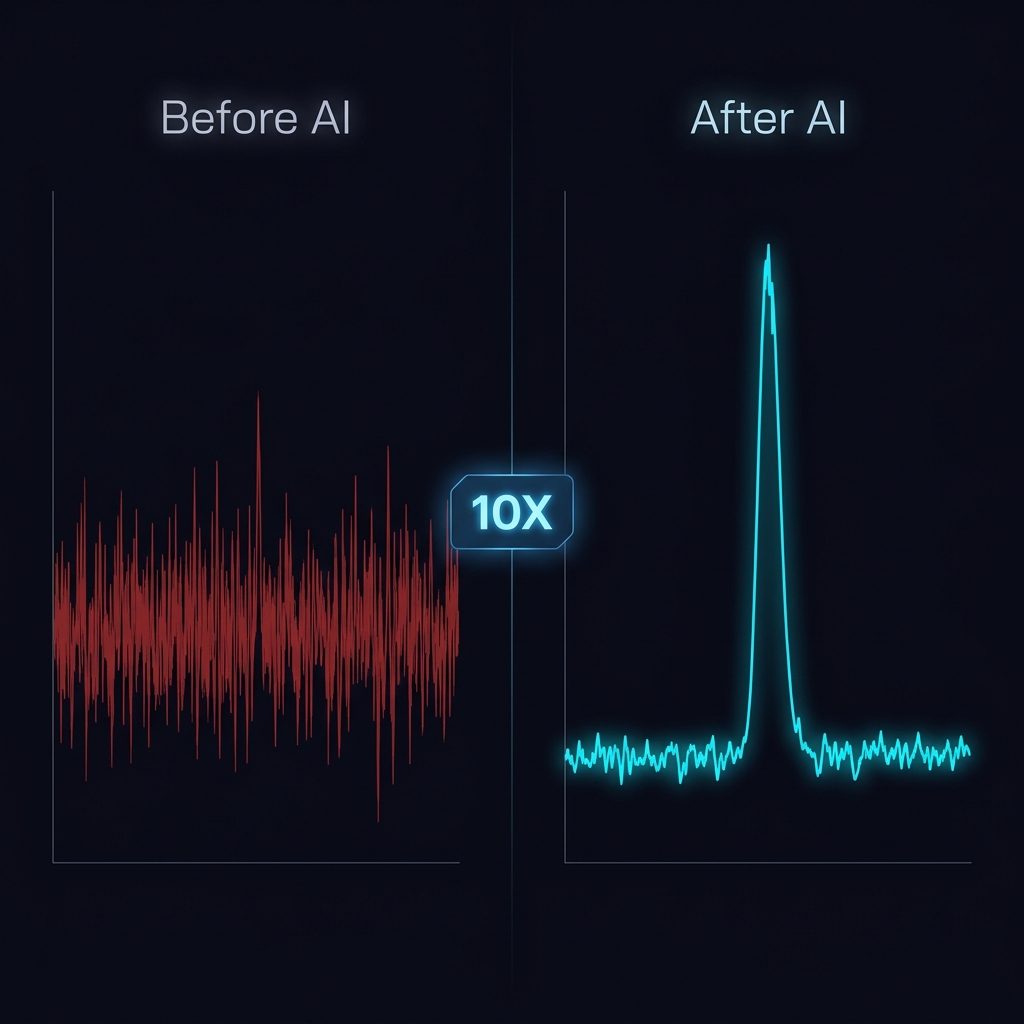
Instead of altering the nanofabrication of the plasmonic sensor, we altered how the data is read.
Neural Denoising at the Extreme Edge
When hydrogen concentrations are incredibly low (parts per million), the optical shift in the sensor is entirely buried in environmental and detector noise. Classical signal processing filters out the noise but inadvertently destroys the faint hydrogen signal along with it.
We trained a highly specialized neural network to understand the precise physical characteristics of both the noise and the true signal. By feeding the raw, unprocessed sensor telemetry into the model, the AI reconstructs the true hydrogen concentration with remarkable precision.
Key Advances from the Research:
- Order of Magnitude Improvement: The AI-augmented readout improved the sensor's sensitivity by a factor of 10, detecting hydrogen at concentrations far below the sensor's native limit of detection.
- Software Over Hardware: Achieved advanced sensor performance using legacy hardware, proving that upgrading software is often cheaper and more effective than deploying new physical infrastructure.
- Real-Time Edge Inference: The neural network runs efficiently on low-power microcontrollers, ensuring continuous, lag-free safety monitoring.
Empowering Industrial Safety
This breakthrough highlights the power of IFLAI's physics-informed approach. By integrating our foundation models, manufacturers can instantly upgrade their existing sensor fleets, achieving state-of-the-art safety and monitoring without the massive capital expenditure of hardware replacements.