Accelerating Plasmonic Hydrogen Sensors via Transformer-Based Deep Learning
Reference: Accelerating Plasmonic Hydrogen Sensors for Inert Gas Environments by Transformer-Based Deep Learning (ACS Sensors, 2025)
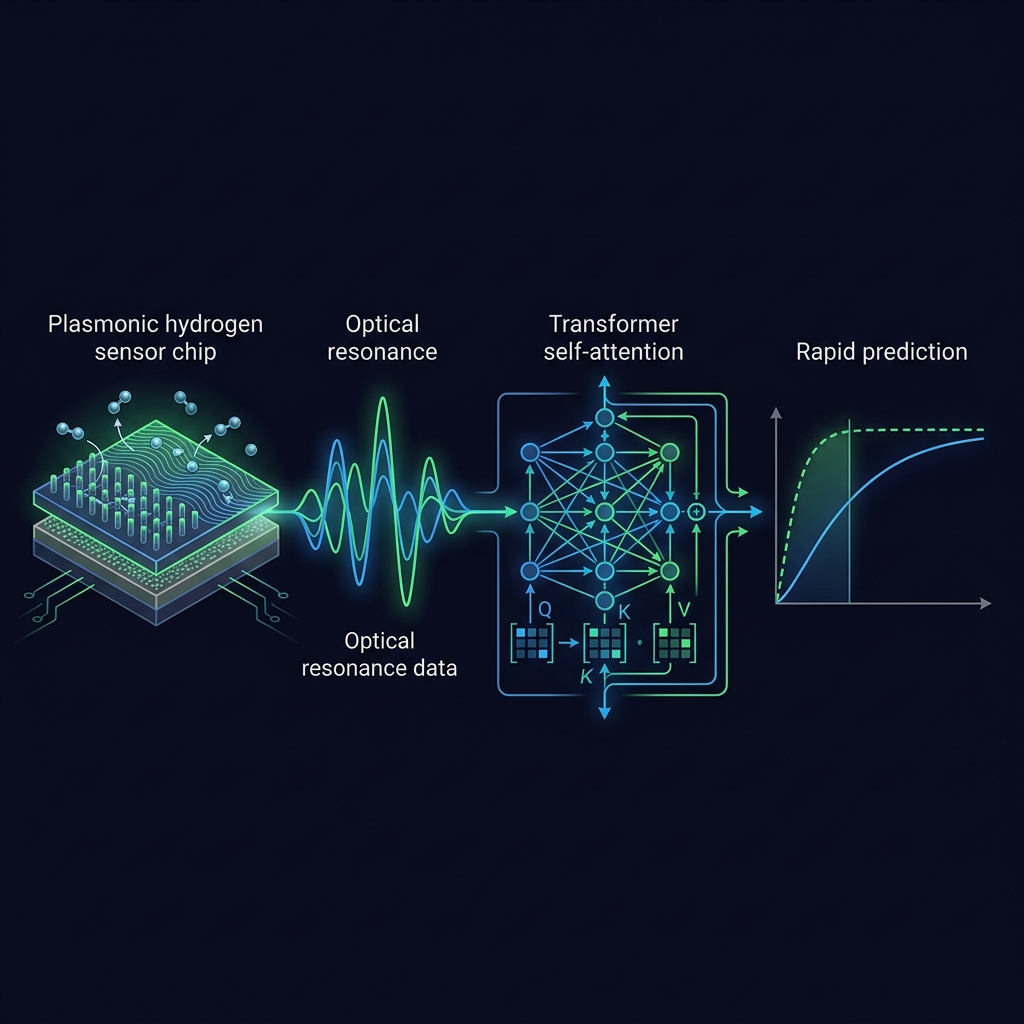
While much of our work focuses on spatial computer vision, temporal data analysis is equally critical in industrial safety. This research focused on a specific hardware limitation: plasmonic hydrogen sensors react too slowly in inert gas environments.
Instead of engineering a new nanomaterial, we asked a software question: Can an AI predict the equilibrium state of the sensor before the physical reaction is complete?
Architecture: The Temporal Transformer
We opted for a Transformer-based architecture over a standard Recurrent Neural Network (RNN). While RNNs process data sequentially (and thus struggle with long-range dependencies and immediate spikes in noise), Transformers utilize Self-Attention.
When the sensor records an optical shift, the Transformer analyzes the entire temporal window simultaneously:
# Simplified Attention Mechanism
Attention(Q, K, V) = softmax( (Q * K^T) / sqrt(d_k) ) * V
By mapping the temporal readouts as Queries (Q), Keys (K), and Values (V), the network learns to pay "attention" only to the specific kinetic signatures of hydrogen absorption, completely ignoring random thermodynamic fluctuations in the optical readout.
The Results
The Transformer model successfully extrapolated the final hydrogen concentration using only the very first fractions of a second of the sensor's response curve.
Performance Metrics:
- Speed: Drastic acceleration in response time, converting a slow, diffusion-limited physical sensor into an instant alert system.
- Deployment: The inference engine was optimized using ONNX, allowing it to run locally on the sensor's micro-controller without requiring cloud compute.
This proves a core IFLAI philosophy: highly optimized, physics-informed software can often outperform million-dollar hardware upgrades.