Analyzing Motion Changes in Single-Particle Experiments
It was late 2024 when our team hit a wall. We were working on phenotypic tracking algorithms, watching single molecules diffuse across cellular membranes.
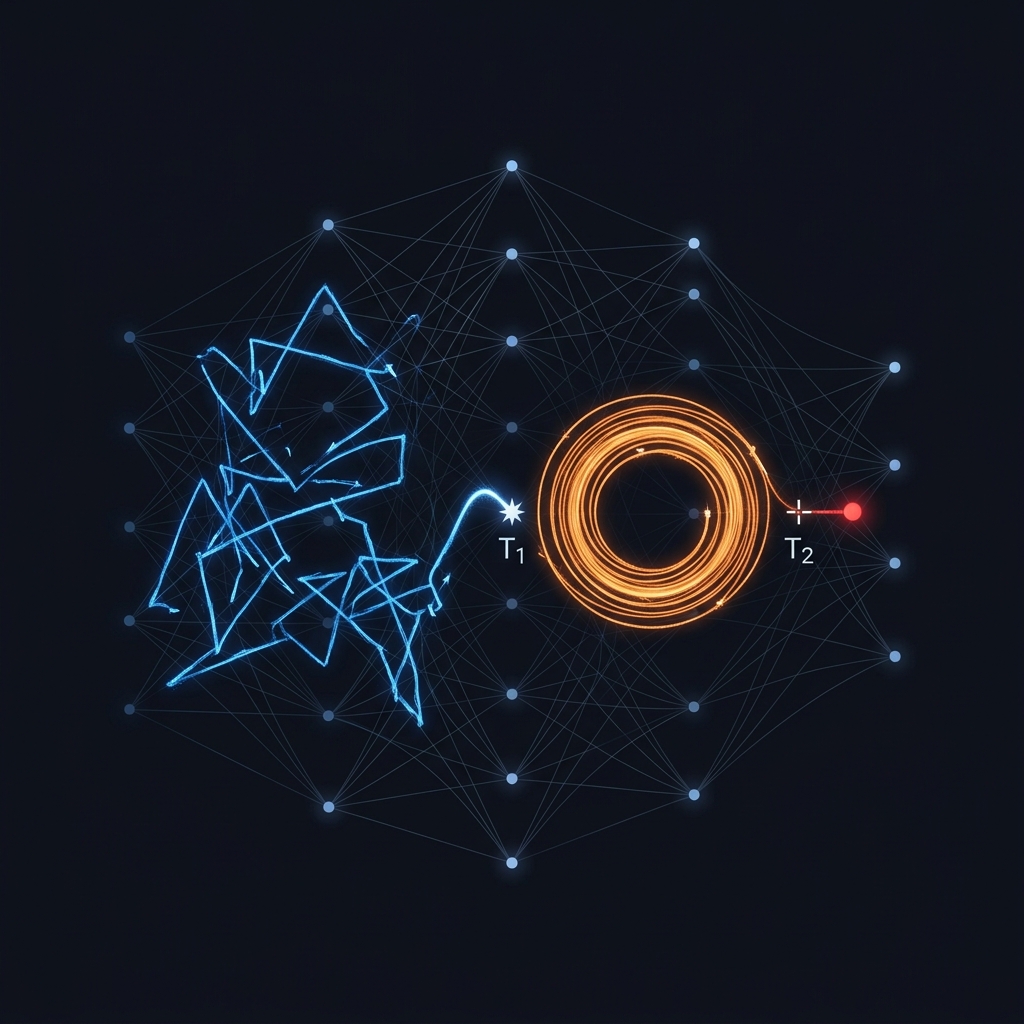
In an ideal world, a molecule moves in a straight line or follows a predictable random walk. But biology is never ideal.
Suddenly, a molecule would hit a lipid raft. Its diffusion state would instantly change from 'free-floating' to 'confined'. A second later, it would bind to a receptor, stopping entirely.
The problem wasn't seeing the molecule; it was proving mathematically exactly when that state change occurred.
We threw the gold standard at the problem: Hidden Markov Models (HMMs). For decades, HMMs have been the go-to tool for inferring hidden states in noisy data. But as the signal-to-noise ratio of our data dropped and our trajectories got shorter, the HMMs began failing. They needed long, stable datasets to build their probabilities, and we simply didn't have them.
Building a Better Benchmark
This frustration led to our paper: Quantitative evaluation of methods to analyze motion changes in single-particle experiments (Nature Communications, 2025).
Instead of just building a new algorithm, we built a comprehensive, rigorous benchmark to evaluate every method attempting to solve this problem. We tested classical statistics against the newest temporal neural networks.
The results were undeniable. Deep learning architectures, specifically those utilizing temporal convolutions, consistently outperformed classical statistical methods. They didn't need long, stable trajectories. They could look at a brief, incredibly noisy, fragmented tracking line and pinpoint the exact millisecond the particle changed its behavior.
Today, this capability is baked into our foundation models. When our clients track drug compounds or viral particles, they aren't just getting lines on a screen. They are getting mathematical certainty about the underlying biological interactions.