Annotation-Free Deep Learning for Quantitative Microscopy
The End of Manual Annotation
For years, the progress of AI in computational biology has been entirely dependent on graduate students and technicians manually drawing bounding boxes around cells. This 2024 PhD Thesis, Annotation-free deep learning for quantitative microscopy, systematically dismantles that paradigm.
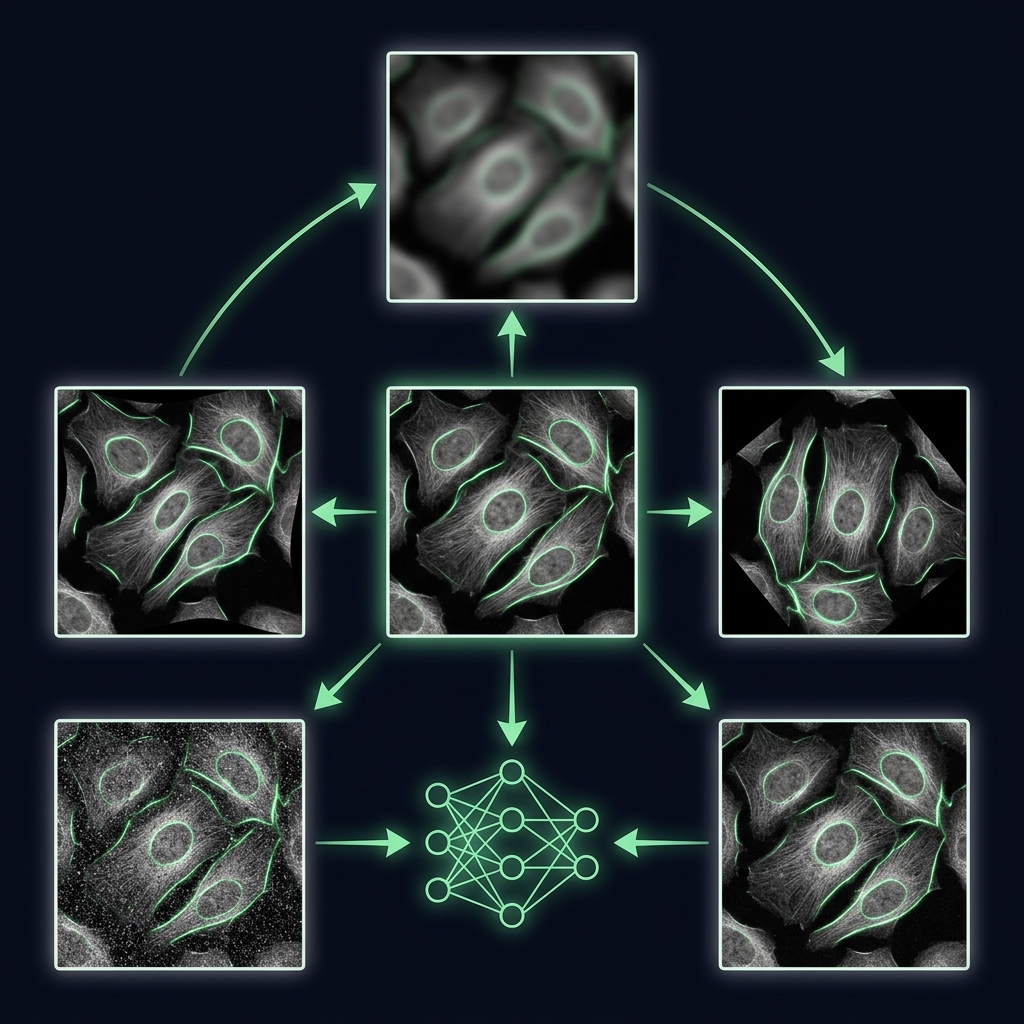
Formalizing Self-Supervised Learning
The thesis provides a comprehensive framework for training highly accurate quantitative models without human intervention. By leaning into self-supervised learning, physics-informed priors, and synthetic data generation, the research proves that human annotation is no longer a strict requirement for state-of-the-art computer vision.
Key Advances Explored:
- Self-Supervised Object Detection: Expanding on earlier work to generalize self-supervised single-shot detection across diverse microscopy modalities.
- Synthetic Data Generation: Utilizing digital twins and optical simulations to generate massive, perfectly annotated datasets entirely in software, bypassing the lab bench.
- Quantitative Reliability: Establishing mathematical bounds on the accuracy of annotation-free models, proving they match or exceed the performance of models trained on human data (which inherently contain human bias).
Empowering the IFLAI Platform
This academic work is directly instantiated in IFLAI's commercial platform. By completely removing the annotation bottleneck, we allow biotech firms to deploy highly accurate detection, tracking, and segmentation models in hours rather than months.