Extracting Quantitative Data from Bright-Field Cells via Deep Learning
Making Bright-Field Brilliant Again
Bright-field microscopy is the oldest, cheapest, and least invasive form of biological imaging. However, because it lacks the high contrast of fluorescence microscopy, researchers have historically treated it as a purely qualitative tool, good for checking if cells are alive, but useless for extracting hard numerical data.
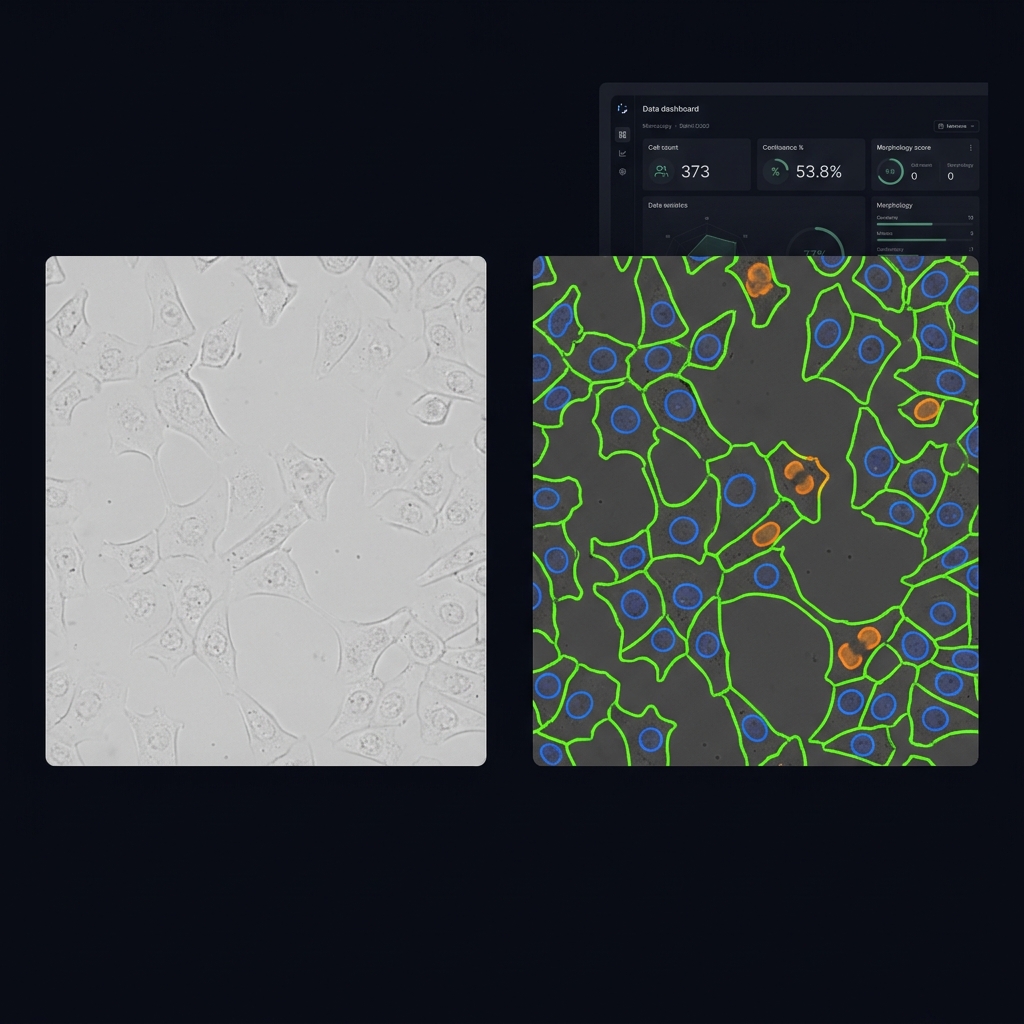
In our 2021 publication in Biophysical Reviews, Extracting quantitative biological information from bright-field cell images using deep learning, we detailed how deep learning is completely changing this narrative.
Unlocking Latent Information
A bright-field image actually contains massive amounts of latent physical information (such as phase shifts caused by cellular organelles). The human eye cannot easily interpret these subtle gradient shifts, but a convolutional neural network can.
We reviewed the emerging landscape of AI architectures capable of segmenting, tracking, and digitally staining bright-field images with unprecedented accuracy.
Key Advances Explored:
- Digital Staining: The mathematical generation of fluorescence-quality images derived entirely from label-free bright-field inputs.
- High-Fidelity Segmentation: Using U-Net and Mask R-CNN architectures to perfectly outline highly transparent, low-contrast cells that previously required manual tracing.
- Automated Phenotyping: Training models to automatically classify cellular health, mitotic state, and drug response strictly from morphological changes visible in bright-field.
The Core of Data Efficiency
This review highlighted early on that the key to unlocking AI in biology was not necessarily building better microscopes, but building better computational priors. This philosophy remains the cornerstone of IFLAI's approach to delivering highly data-efficient computer vision software.