IFLAI CHROMA 1 is now agent-ready
High-performing Cell Painting representations, now directly accessible to scientific AI agents through MCP
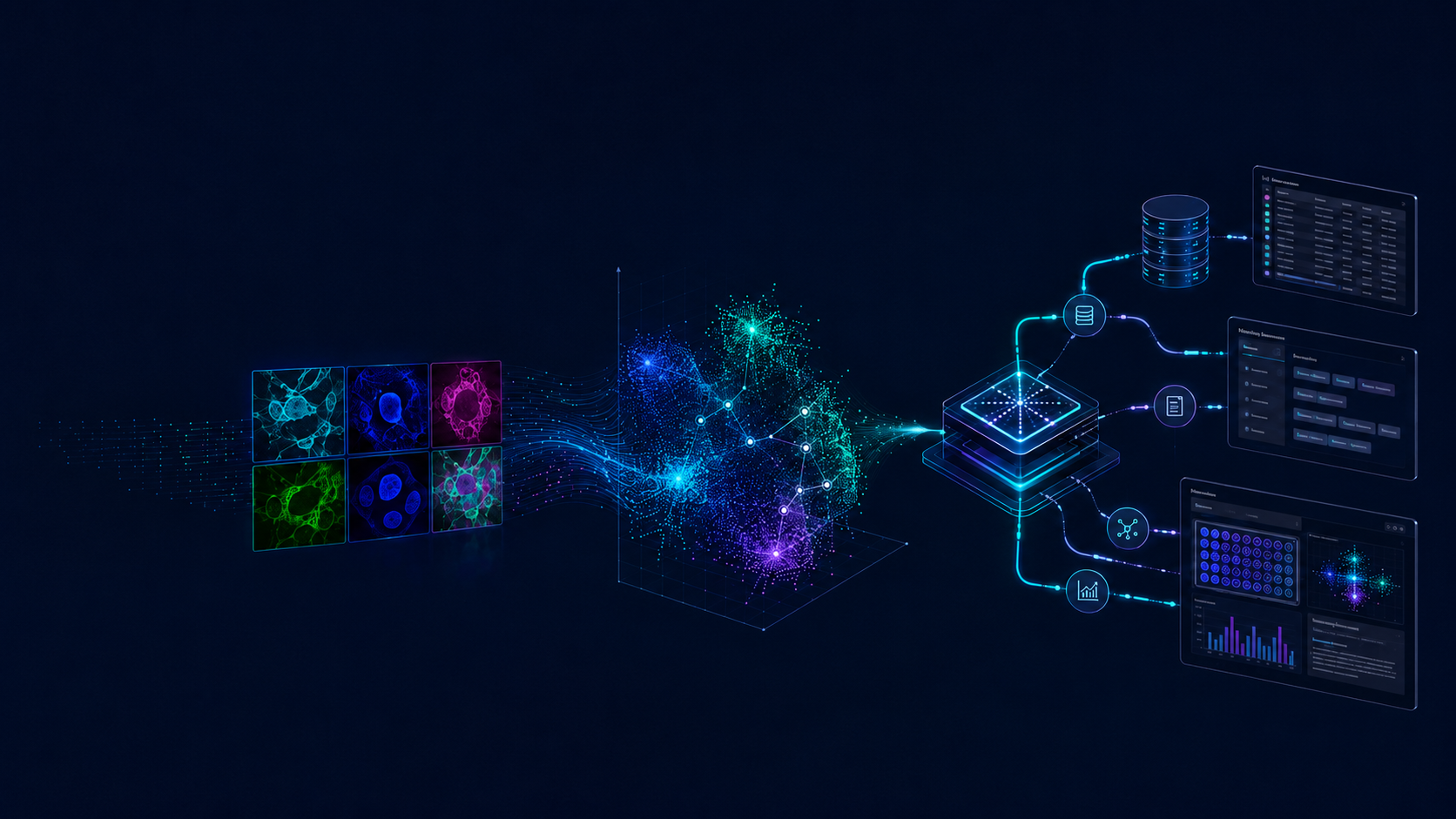
Phenotypic screening models are most useful when they can operate directly inside the workflows where scientific decisions are made.
In practice, however, even a strong model may remain isolated behind a separate analysis pipeline. Scientists must move data between image repositories, metadata systems, quality-control tools and downstream databases, and then manually reconnect the results to the experimental context from which they originated.
To remedy this, IFLAI CHROMA 1 is now integrated through the Model Context Protocol, or MCP. This enables scientific AI agents to call CHROMA 1 as a specialised morphology-analysis capability, combine its outputs with experimental metadata and other laboratory systems, and use the resulting representations inside broader screening workflows.
The practical consequence is that CHROMA 1 no longer needs to be treated as a separate analytical destination.
It is now an agent-ready component for pharmaceutical phenotypic screening.
From strong embeddings to usable workflows
CHROMA 1 was developed to learn reusable biological representations directly from raw, multichannel Cell Painting images.
On the RxRx3-core benchmark, CHROMA 1 achieves the highest aggregate retrieval score in our current comparison while using substantially less training data, compute and model scale than leading published alternatives. It also leads on three of four biological retrieval benchmarks, indicating that its representations capture biologically meaningful structure rather than only generic visual similarity.
However, strong embeddings are only one part of a useful screening system.
A real screening workflow also involves microscopy image repositories, plate metadata, compound libraries, reference perturbations, quality-control criteria, biological annotations, downstream databases and scientific reporting. Traditionally, connecting these components requires either a separate analytics environment or substantial custom integration work.
The MCP integration addresses this limitation by exposing CHROMA 1 through clearly defined operations that an agent can invoke as part of a larger scientific workflow.
The model remains specialised. The integration makes that specialisation directly usable.
What MCP enables
Instead of requiring scientists to move manually between tools, MCP provides an agent with a controlled interface to CHROMA 1.
Depending on the deployment, an agent can use CHROMA 1 to:
- generate embeddings from raw multichannel microscopy images;
- construct well- or perturbation-level morphology profiles;
- retrieve phenotypically similar compounds or genetic perturbations;
- compare experimental conditions;
- identify batch shifts or out-of-domain samples;
- rank informative samples for active learning or follow-up experiments;
- return structured results for downstream interpretation and reporting.
Importantly, the division of responsibilities remains clear.
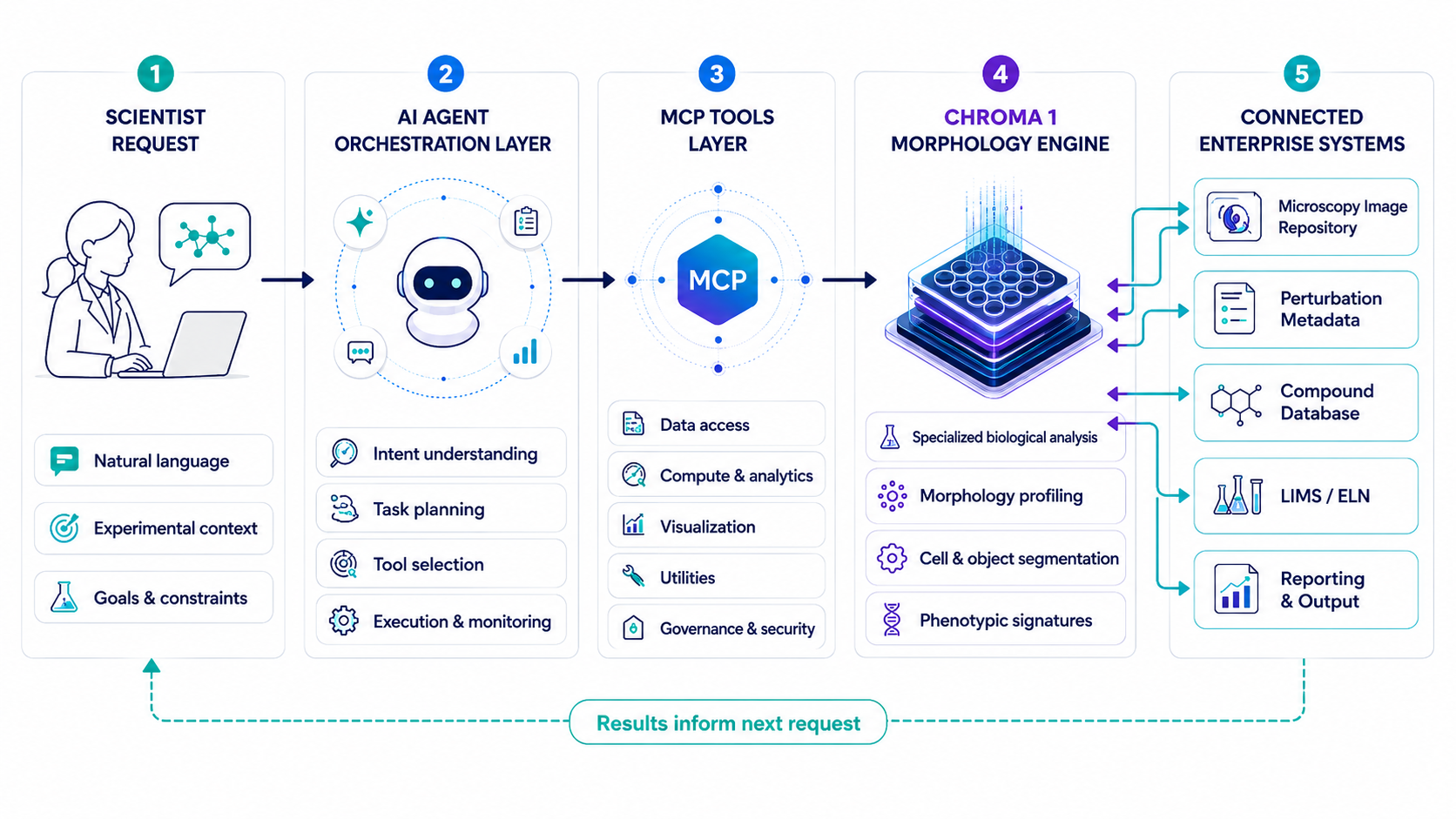
CHROMA 1 performs the specialist morphology analysis. The agent coordinates the sequence of operations. The surrounding scientific systems remain the sources of truth for images, metadata, permissions and reporting context.
What this looks like in practice
A scientist might ask:
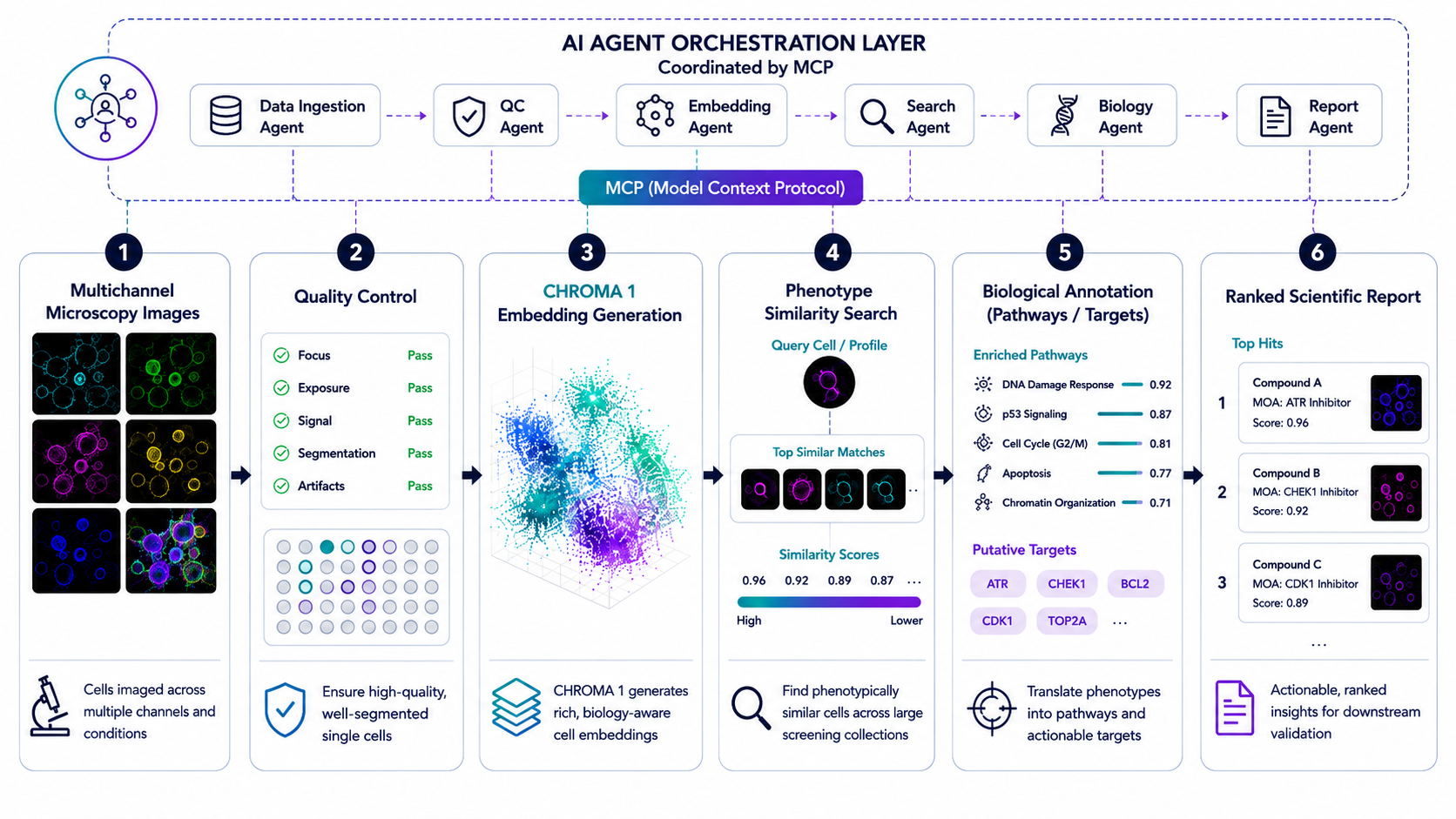
Find the compounds in this screen that produce a phenotype similar to the reference treatment. Exclude low-quality wells, group the strongest matches by biological annotation, and prepare a ranked report with links to the source images.
With the MCP integration in place, this request can be translated into a coordinated and traceable sequence:
- Retrieve the relevant images, plate metadata and experimental context from the connected systems.
- Apply the approved quality-control criteria and exclude unsuitable wells.
- Run CHROMA 1 to generate image-level morphology embeddings.
- Aggregate the embeddings into well- or perturbation-level profiles.
- Search the selected reference set for phenotypically similar compounds or perturbations.
- Combine the retrieved results with target, pathway and assay annotations.
- Return a ranked report containing the relevant metadata, source-image links and intermediate results for scientific review.
The important shift is not that the agent replaces the scientist or the underlying laboratory systems.
Rather, the agent can coordinate these systems while invoking CHROMA 1 at the point where specialised morphology analysis is required. The model therefore becomes part of the workflow itself, rather than a separate tool that must first be manually wrapped and integrated.
Why this matters
Many current AI systems in pharmaceutical research still behave as isolated applications.
One tool analyses images. Another manages experimental metadata. A third searches compounds or perturbations. A fourth produces reports. The individual components may be capable, but the user is still required to bridge the interfaces between them.
By making CHROMA 1 callable through MCP, the morphology layer becomes modular, reusable and composable.
This allows the same CHROMA 1 capability to participate in:
- hit triage;
- phenotypic similarity search;
- morphological clustering;
- assay and condition comparison;
- mechanism-oriented follow-up;
- active sample selection;
- downstream reporting and decision support.
Thus, CHROMA 1 is no longer only a phenotypic foundation model with strong benchmark performance.
It becomes a specialised biological capability that can be integrated into broader agent-coordinated screening systems.
Built for real screening environments
This does not mean replacing existing laboratory systems with one monolithic AI model.
Rather, the goal is to make a specialised model usable inside controlled scientific and enterprise environments, while preserving the systems that already manage experimental data, governance and domain context.
Through MCP, CHROMA 1 can be integrated with:
- microscopy image repositories;
- perturbation and compound metadata;
- LIMS and ELN systems;
- internal screening software;
- downstream interpretation and reporting layers.
This separation is important. The surrounding systems retain responsibility for data storage, permissions and experimental context, while CHROMA 1 provides a reusable morphology-analysis layer.
In practice, this means that the same CHROMA 1 capability can support different user interfaces, agent frameworks and screening workflows without rebuilding the model integration from the beginning each time.
Conclusion
We see this as an important step in how scientific AI should be deployed.
The objective is not to build one general-purpose model that attempts to replace every part of the scientific workflow. It is to construct a coordinated system in which specialised models, agents and laboratory infrastructure each perform the task for which they are best suited.
CHROMA 1 provides the morphology-analysis layer.
MCP makes that layer directly callable inside scientific workflows.
Taken together, this makes CHROMA 1 not only a high-performing foundation model, but a usable component of the screening system itself.