Inductive Biases for Efficient Deep Learning in Microscopy
Teaching AI the Rules of Physics
Deep learning is notoriously data-hungry because standard architectures (like standard CNNs or MLPs) start as blank slates. They have to learn everything from scratch, including the basic laws of physics governing light, optics, and geometry.
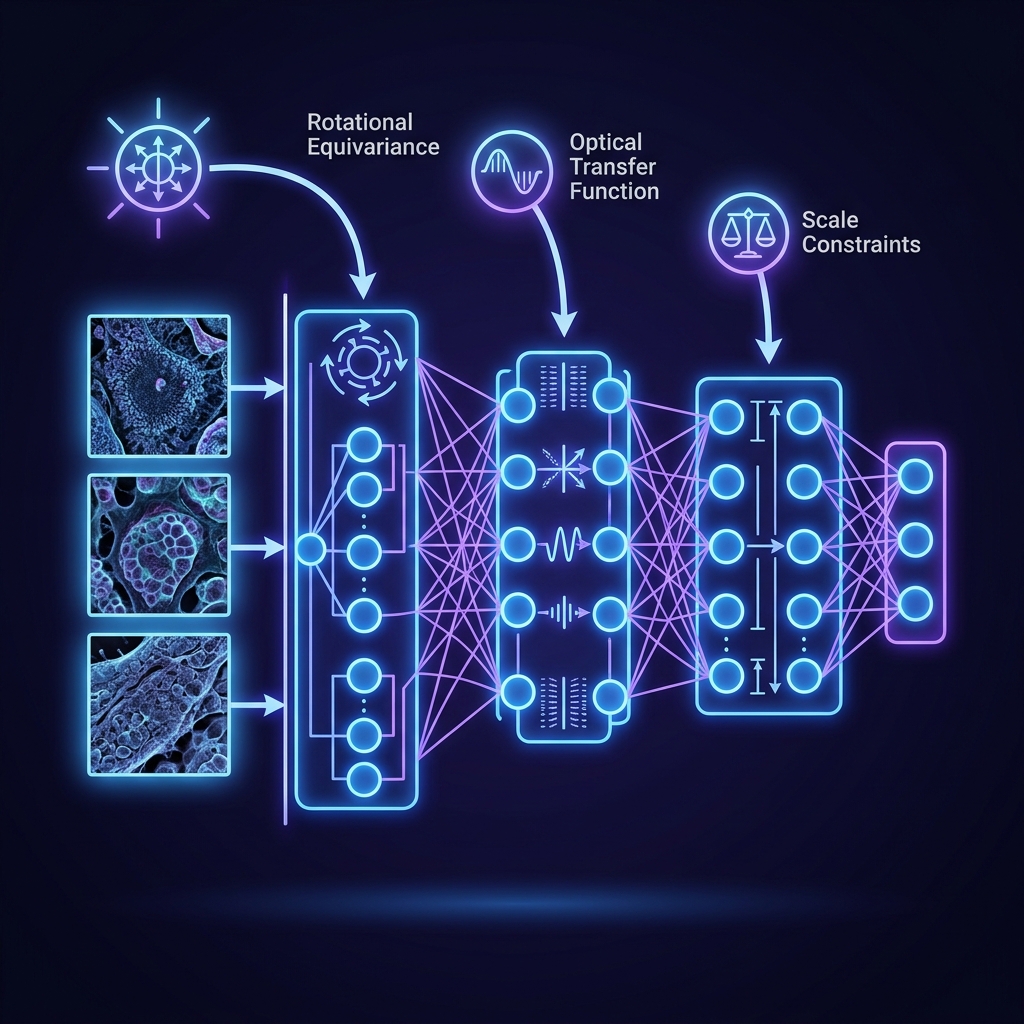
The 2025 PhD Thesis, Inductive Biases for Efficient Deep Learning in Microscopy, explores the mathematical countermeasure to this problem: Inductive Biases.
What is an Inductive Bias?
An inductive bias is an assumption built directly into the mathematical architecture of a learning algorithm. For example, Convolutional Neural Networks assume that local pixel neighborhoods are related (translation invariance).
In this thesis, we explored how introducing strict, physics-informed inductive biases into models used for microscopy drastically reduces the amount of training data required. If the network mathematically already knows how light scatters through a lens, it doesn't need 10,000 images to learn it.
Key Advances Explored:
- Equivariant Networks: Designing models that mathematically guarantee rotational and translational symmetry, eliminating the need for data augmentation.
- Physics-Informed Loss Functions: Constraining the network's predictions to physically plausible biological states, preventing hallucinations in low-data regimes.
- Data Efficiency: Proving that highly biased architectures can achieve state-of-the-art accuracy with order-of-magnitude less training data than standard models.
The IFLAI Philosophy
This thesis forms the academic backbone of IFLAI's core claim: Great AI does not need big data. By meticulously designing our foundation models with the correct optical and physical inductive biases, we allow our clients to train highly accurate detection and segmentation models using only 1 to 5 datapoints.