Label-Free Nanofluidic Scattering Microscopy
Observing Molecules in Their Natural State
Fluorescent labels have revolutionized biology, but they come with a massive caveat: attaching a massive glowing fluorophore to a tiny biomolecule often changes how that molecule behaves.
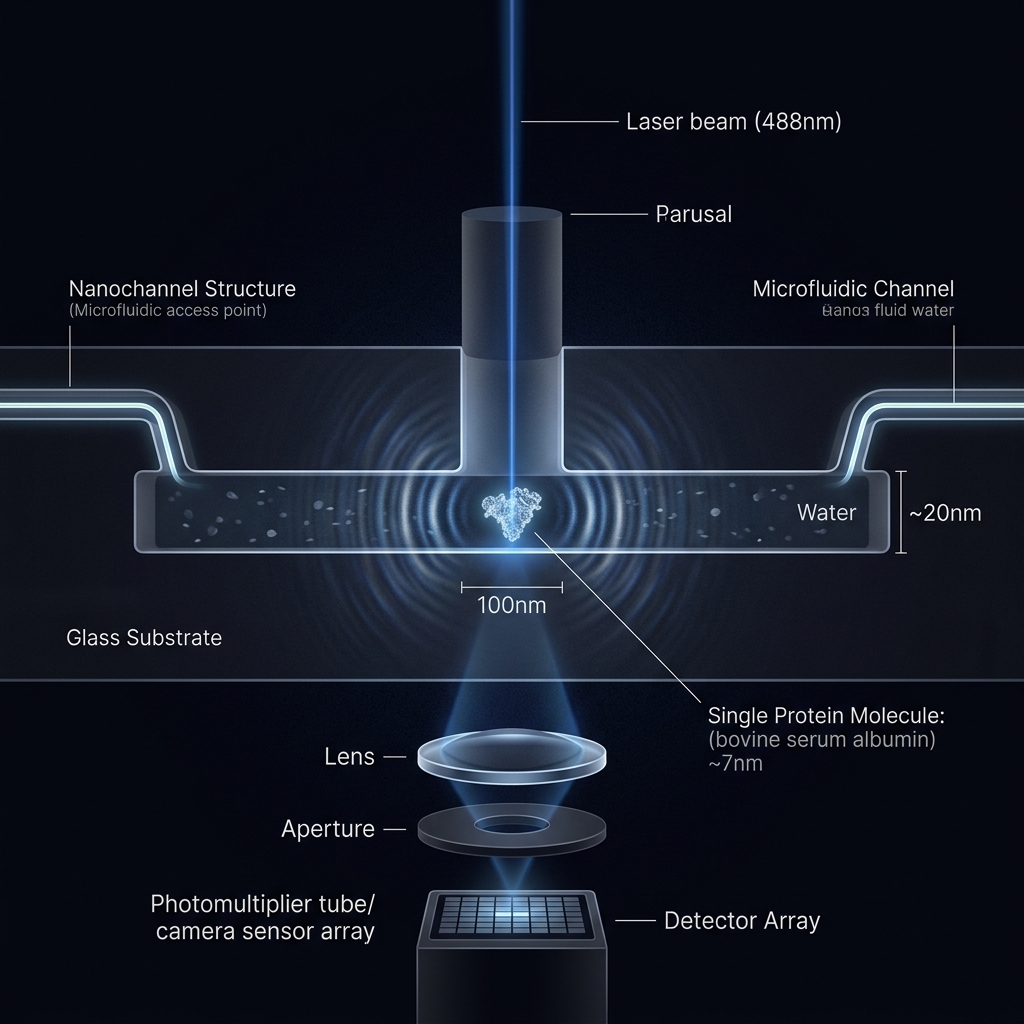
In 2022, we published Label-free nanofluidic scattering microscopy of size and mass of single diffusing molecules and nanoparticles in Nature Methods, demonstrating a viable path forward for completely non-invasive single-molecule characterization.
The Power of Scattering
Instead of forcing the molecule to emit light, we simply observed how it scattered light as it diffused through a nanofluidic channel. By meticulously measuring the interference patterns generated by the scattered light, we could deduce both the hydrodynamic radius (size) and the optical polarizability (mass) of the particle.
The primary hurdle was computational: the scattering signal from a single protein is incredibly faint.
Key Advances from the Research:
- Label-Free Characterization: Successfully measuring the mass and size of native, unlabeled proteins and synthetic nanoparticles in real-time.
- Computational Denoising: Deploying advanced algorithms to isolate the sub-wavelength scattering interference from the dominant background reflections of the nanofluidic chip itself.
- High-Throughput Potential: Proving that optical scattering can serve as a highly scalable alternative to mass spectrometry for certain classes of biomolecules.
Setting the Stage for AI
While this paper utilized advanced signal processing, the extreme noise environments encountered during this research highlighted the immediate need for deep learning. This project directly catalyzed the subsequent development of our Vision Transformer architectures, solidifying IFLAI's commitment to pushing the boundaries of label-free imaging.