Materials for Tomorrow 2024: The Future of AI in Material Science
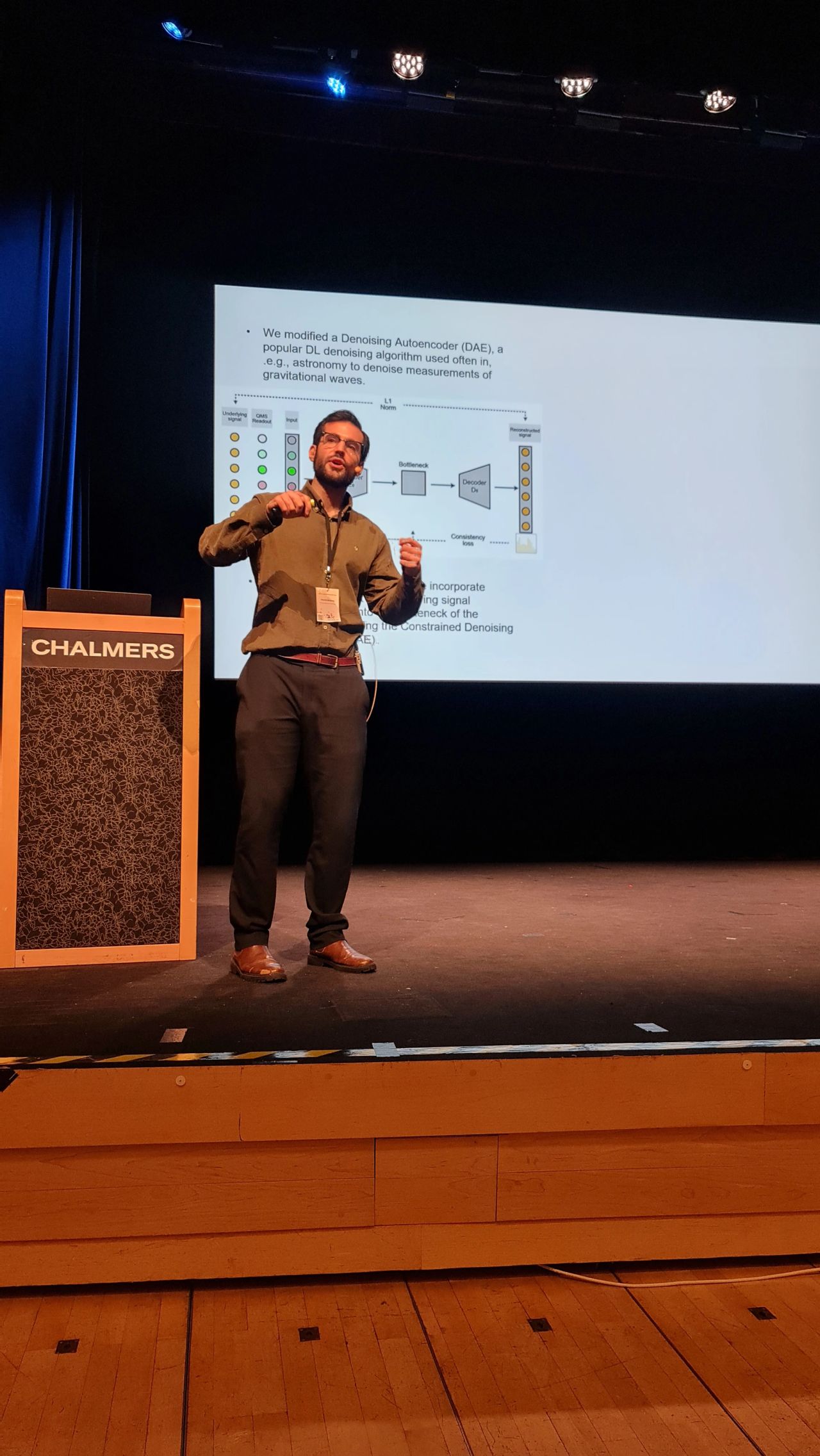
On October 31st, 2024, IFLAI had the opportunity to present at the Materials for Tomorrow Conference, an incredible gathering of researchers and industry leaders hosted at Chalmers University of Technology.
The conference focused on the cutting-edge developments in material science, and our presentation explored the critical role that physics-informed artificial intelligence plays in this rapidly evolving field.
Pushing the Boundaries of Microscopy and Spectroscopy
During the presentation, our CTO, Henrik Klein Moberg, discussed how our core hypothesis (that deep learning can substantially improve the sensitivity and specificity of single-molecule microscopy, optical sensing, and mass spectrometry) is actively being realized.
By integrating physical priors into our architectures, we are able to denoise complex signals and extract meaningful data from minute, previously obscured measurements.
The Constrained Denoising Autoencoder (CDAE)
A major highlight of the talk was our work on the Constrained Denoising Autoencoder (CDAE). While standard Denoising Autoencoders (DAEs) are popular for tasks like denoising gravitational waves, they often struggle with the complex, non-linear noise found in single-particle optical sensing.
By incorporating explicit physical conditions about the underlying signal directly into the bottleneck of the encoder, the CDAE achieves significantly higher precision with a fraction of the training data.
Deep Learning Crash Course
We also took the opportunity to highlight our upcoming textbook, the Deep Learning Crash Course: A Hands-On, Project-Based Introduction to Artificial Intelligence. Published by No Starch Press, the book provides a technically-focused, practical guide to AI for data analysis, spanning everything from image recognition and self-supervised learning to geometric and reinforcement learning.
It was an inspiring event, and we are deeply grateful to the organizers for fostering such an engaging environment for cross-disciplinary innovation!