Online Mass Spectrometry of Single Catalyst Nanoparticles via Deep Learning
Publication: Nature Communications, 2025 Link: Read the full paper
The Problem
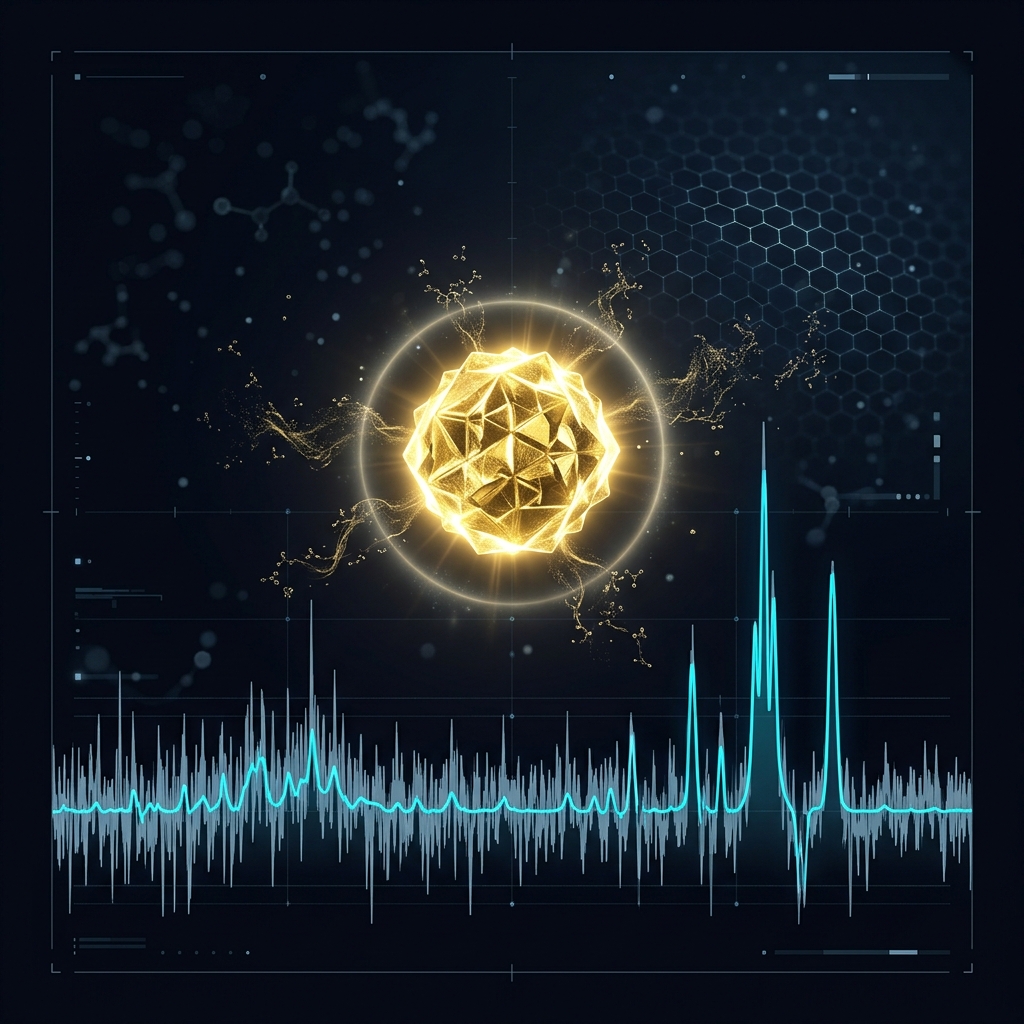
In chemical engineering and green energy development, understanding how a catalyst performs is critical. However, analyzing the reaction products of a single catalyst nanoparticle in real-time has long been considered computationally impossible. The signal generated by a single nanoparticle in a mass spectrometer is so incredibly weak that it is almost entirely masked by thermal and detector noise. Classical signal processing filters out the noise, but inadvertently destroys the faint reaction signal along with it.
The AI Approach
To solve this, we bypassed classical filters entirely. We engineered a highly specialized neural network trained specifically on the physics of the mass spectrometer's detector noise and the diffusion characteristics of the reaction products.
Because the network was trained with strict inductive biases regarding how the noise behaves, it acts as an intelligent, dynamic filter. As raw, raw telemetry streams into the system, the AI performs "online" (real-time) denoising, stripping away the chaos while perfectly preserving the catalytic signal.
The Impact
We achieved the unprecedented ability to monitor the catalytic turnover of an isolated nanoparticle in real-time.
For the industrial sector, this is a game-changer. Chemical manufacturers and green energy labs no longer have to rely on macroscopic, generalized data to infer catalytic efficiency. By deploying IFLAI's data-efficient denoising models, researchers can screen nanostructured materials with unparalleled precision, rapidly accelerating the transition to sustainable chemical synthesis.