Eliminating the Annotation Bottleneck: Single-Shot Self-Supervised Object Detection
Our 2022 paper, Single-shot self-supervised object detection in microscopy (Nature Communications), fundamentally changed how we build AI. We sat down with the research team to break down exactly what this means for the industry.
Q: Before this paper, how was object detection handled in microscopy?
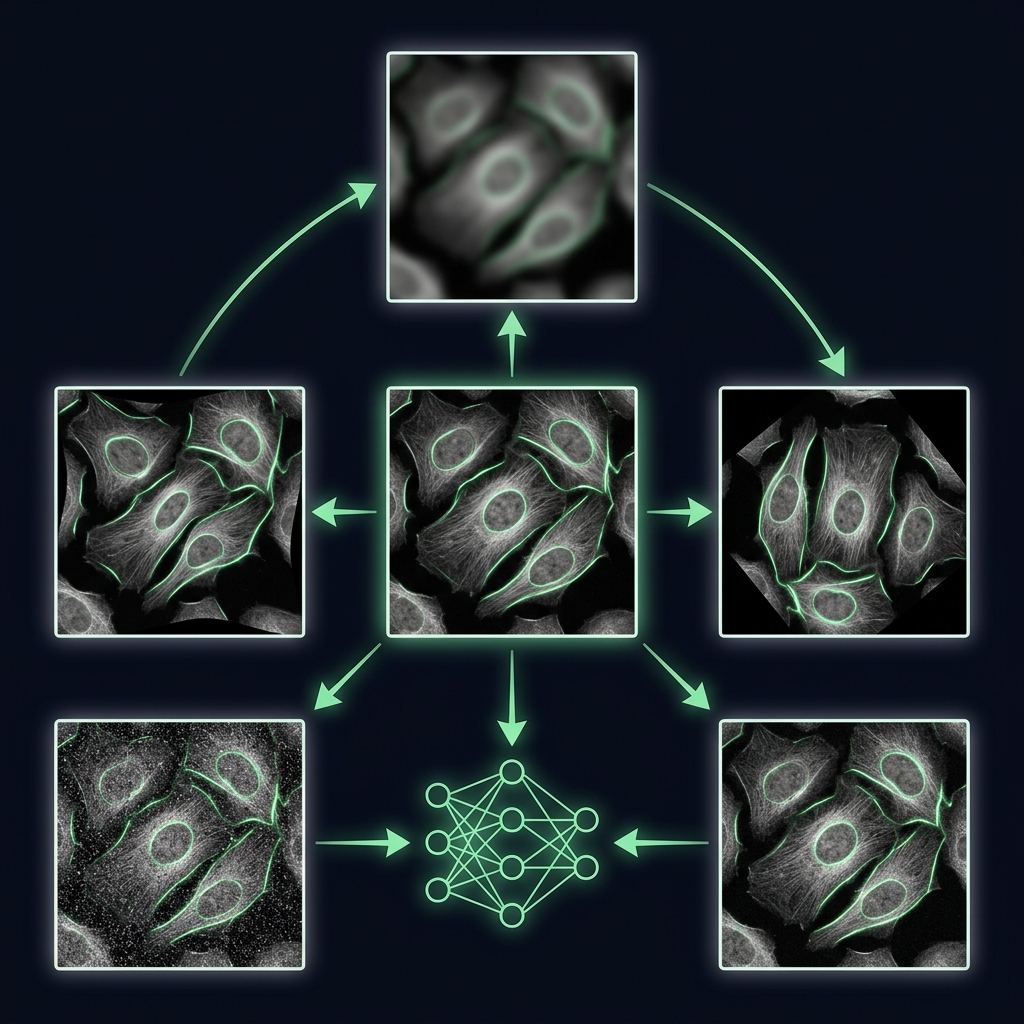
A: Brutal, manual labor. If you wanted an AI to find a specific type of cell, you had to have a human expert sit down and draw bounding boxes around thousands of examples of that cell. It’s called supervised learning. It's expensive, it's slow, and honestly, humans are terrible at being perfectly consistent, which confuses the AI.
Q: So what exactly is 'Self-Supervised Learning' in this context?
A: We realized that an AI doesn't actually need a human to tell it what an object is. It just needs to understand the rules of physics. We created a system that takes a single unannotated microscopic image and subjects it to extreme computational torture: we blur it, warp it, add noise, and flip it.
We then force the neural network to mathematically deduce which structures remain consistent across all those distortions. Those consistent structures are the "objects." The background noise disappears because it's mathematically chaotic.
Q: The paper says "Single-Shot". Does that mean you only used one image?
A: Exactly. Because the self-supervised loop is so powerful, the network can converge and figure out the structural signature of a target from just one representative micrograph.
Q: Why should a biotech executive or lead engineer care about this?
A: Because it eliminates the annotation bottleneck entirely. You no longer need to spend three months building a training dataset before you can start your assay analysis. You can take a single image from your microscope, feed it to our foundation model, and have a production-ready tracking pipeline deployed by the end of the day.
Read the full mathematical methodology in Nature Communications