Spatial Clustering of Single-Molecule Localizations via Graph Neural Networks
Executive Summary
Publication: Enhanced spatial clustering of single-molecule localizations with graph neural networks (Nature Communications, 2025). Read Paper
The Objective: In Single-Molecule Localization Microscopy (SMLM), translating millions of isolated coordinate points into distinct biological structures (protein clusters, membranes) requires advanced clustering algorithms.
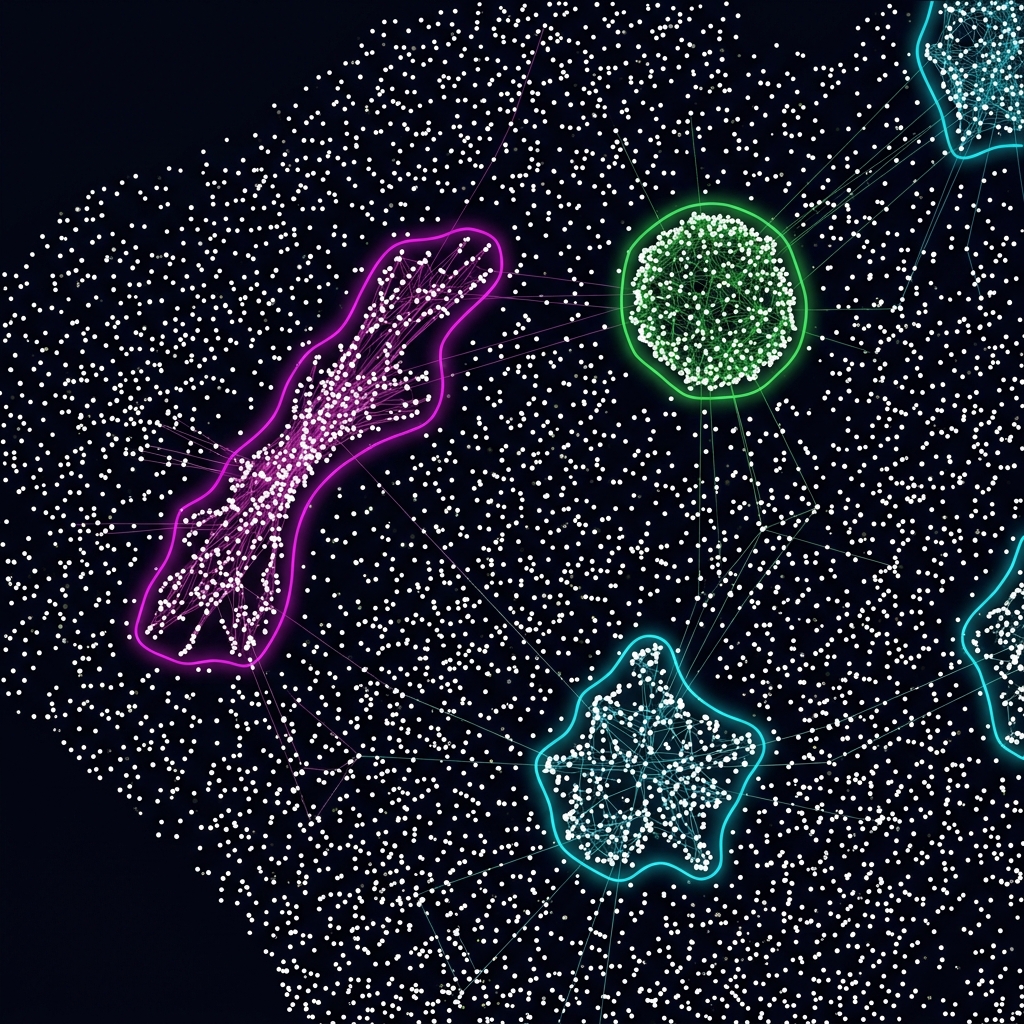
The Limitation of Legacy Tech: Standard algorithms like DBSCAN rely on density. They fail catastrophically when background noise varies across the image or when biological clusters form complex, non-spherical shapes (e.g., fibrillar structures).
The IFLAI Solution: We abandoned density-based clustering and utilized topology. By converting the SMLM coordinate data into an interconnected graph, we deployed a Graph Neural Network (GNN).
- The GNN learns the structural "signature" of a true biological cluster based on node connectivity.
- It completely ignores local density fluctuations.
- It seamlessly maps irregular, highly complex geometries.
Business Impact: For laboratories and biotech firms utilizing SMLM, this GNN-based architecture completely eliminates the need for manual parameter tuning. It provides fully automated, highly accurate segmentation of complex nanostructures, accelerating high-throughput structural biology pipelines.