The AI Risk Framing Problem: Extremes and Agendas
The conversation surrounding artificial intelligence risk has become increasingly loud and, simultaneously, increasingly unhelpful. It is typically framed in polarizing extremes: either AI will inevitably lead to an unemployed, dystopian anarchy, or it will usher in a boundless utopia where humans live a life of total leisure.
Neither of these extrapolations is grounded in historical precedent or current data. Instead, they reflect a framing problem: how one frames AI risk is often more correlated with the person writing (and their underlying agenda) than with any anchor in reality. Let's examine both extremes and compare them to the actual, measurable impact of AI on the modern workforce.
The Dystopian Extreme: Unemployed Anarchy
The most common apocalyptic narrative points to the shifting labor market. It is true that general software engineering job postings have experienced a significant contraction. Following the massive hiring surge during the pandemic, active job listings for traditional software roles on major platforms hit multi-year lows by 2025 [1]. Companies, responding to higher interest rates and a shift from growth-at-all-costs to profitability, have prioritized leaner, more efficient teams.
It is easy to extrapolate from this data that we will all soon lose our jobs, leaving society in the hands of a few wealthy tech actors. However, this ignores the other half of the equation: the explosion of specialized demand.
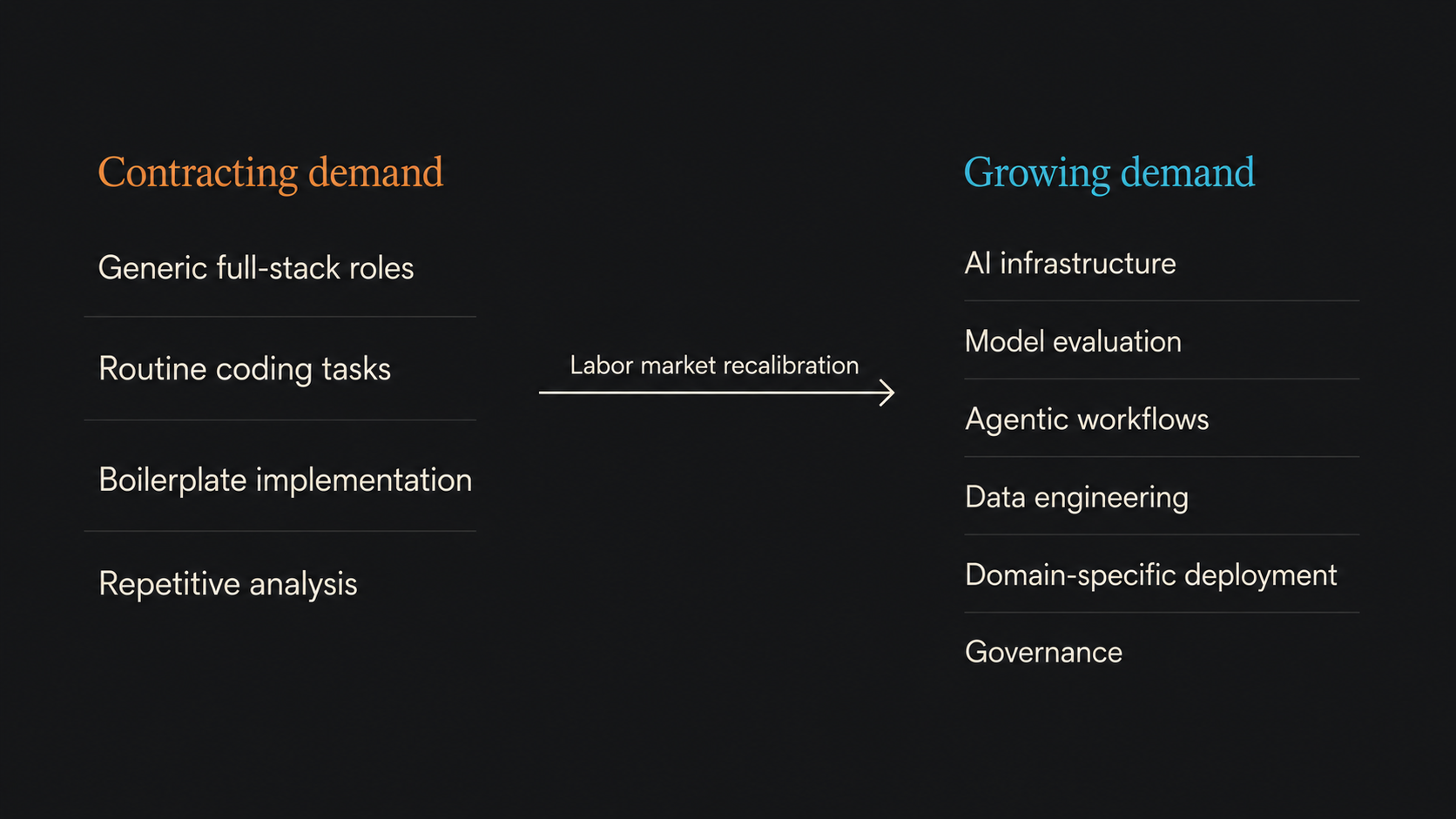
While generalist full-stack roles have cooled, there has been an unprecedented surge in specialized engineering. Roles focusing on artificial intelligence, machine learning infrastructure, prompt engineering, and the development of agentic workflows have seen exponential growth [2]. The labor market isn't vanishing; it is bifurcating and recalibrating. Just as the spreadsheet eliminated the role of human "calculators" but created millions of jobs in financial analysis and accounting, modern AI is displacing generalized coding tasks while simultaneously creating entirely new categories of high-value human labor. Long-term projections from the Bureau of Labor Statistics continue to project growth for software developers that outpaces the average for all occupations [3].
The Utopian Extreme: Boundless Overproductivity
On the other side of the spectrum is the utopian view: AI will make us so productive that we will only need to work a few hours a week.
Proponents of this view point to very real, impressive statistics. According to the 2025 DORA report and various industry surveys, over 80% of developers report that AI coding assistants enhance their productivity [4]. Empirical studies from McKinsey and independent researchers show speedups of 20% to 55% for specific, isolated coding and data analysis tasks [5]. If a worker can do in two hours what used to take eight, the extrapolation suggests a looming era of boundless leisure.
This narrative completely ignores the fundamental realities of organizational economics and the Jevons Paradox. Formulated in 1865 regarding coal consumption, the paradox observes that increasing the efficiency of a resource's use leads to an increase in its total consumption, not a decrease [6]. In the modern workplace, that resource is human time and cognitive capacity.
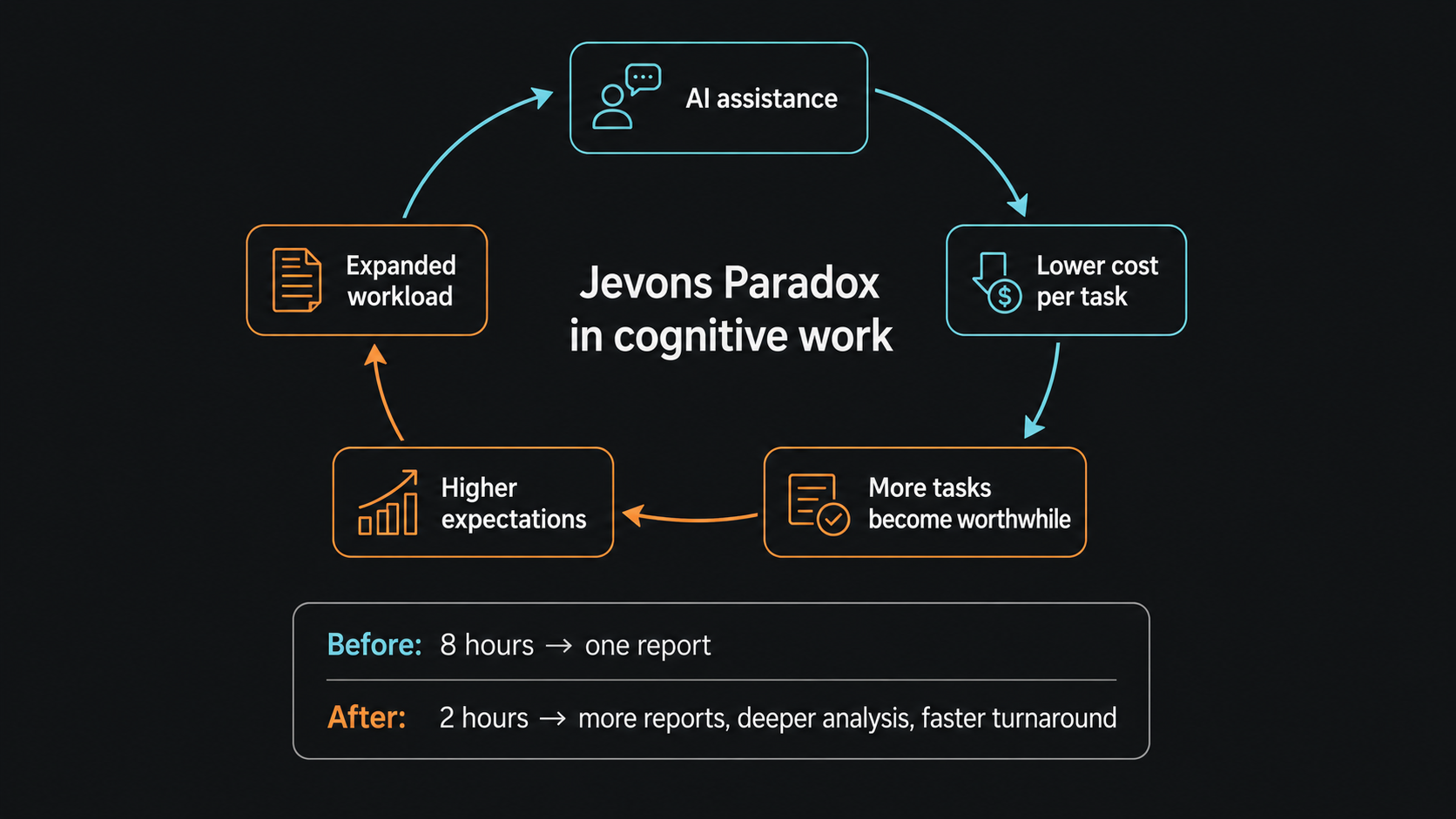
If it becomes cheaper and faster to write software, analyze data, or generate reports, organizations do not send their employees home at noon. They simply raise the bar. They demand more features, deeper analysis, and more complex systems. Because the "cost" of producing work drops, the "demand" for work skyrockets.
In fact, a recent National Bureau of Economic Research (NBER) study indicated that workers in highly AI-exposed roles often end up working more hours, reinvesting their saved time back into expanded expectations and new scopes of work [7]. Similarly, surveys from Upwork have shown that a significant majority of employees (around 77%) feel that new productivity tools have ultimately added to their workload rather than reducing it [8]. Making work faster simply creates the opportunity for more of it.
The Reality of Transformative Technology
How one frames AI risk is therefore more correlated with the person writing and their agenda than reality. Doomsayers sell clicks, fear, and consulting hours; utopians sell software subscriptions and venture capital dreams.
In reality, there is no such thing as a riskless transformative technology. The advent of electricity, the internal combustion engine, and the internet all carried profound risks, displaced certain types of labor, and drastically altered the fabric of society. Yet, none resulted in the total collapse of human agency, nor did they create a perfect utopia.
AI will be the same. The real risks of AI are not found in these science-fiction extremes. They are found in the mundane, complex challenges of our time: ensuring data efficiency, mitigating algorithmic bias, managing the massive energy demands of compute clusters, and navigating the difficult transition periods for displaced workers. Addressing these real-world challenges requires moving past polarized extremes and focusing on building responsible, physics-informed, and sustainable AI solutions.
References
- [1] Data on software engineering job posting contractions: Business Insider / Pragmatic Engineer hiring trends (2024-2025).
- [2] Growth in specialized AI and agentic roles: CodeSmith and industry market analyses (2025).
- [3] Long-term software developer job growth projections: U.S. Bureau of Labor Statistics (BLS) 2024-2034 Outlook.
- [4] AI coding assistant adoption and perceived productivity: DORA Report 2025 / Google Engineering Productivity Studies.
- [5] Empirical task speedups using generative AI: McKinsey & Company: The economic potential of generative AI.
- [6] Jevons Paradox and resource consumption: William Stanley Jevons, The Coal Question (1865).
- [7] AI exposure and working hours: National Bureau of Economic Research (NBER) studies on automation and labor (2024).
- [8] Productivity tools increasing workload: Upwork Research Institute: The AI Productivity Paradox (2024).