The Death of the Black Box: When AI Must Show Its Work
There is a version of AI that works like this: data goes in, a prediction comes out, and nobody can explain what happened in between.
For consumer recommendations, that is often fine. If a music app suggests a song you do not like, the cost is a skipped track.
But in a pharmaceutical laboratory, a manufacturing line, or a clinical imaging pipeline, the cost of an unexplainable prediction is very different. A model that confidently classifies a cell phenotype, approves a batch, or flags a defect needs to do more than produce a number. Someone needs to understand why.
Not because interpretability is fashionable. Because in regulated, high-stakes environments, a model that cannot show its work is a model that cannot be deployed.
That is the real reason the black box is dying. Not because researchers have become curious. Because the industries that need AI most are the ones that can least afford to trust outputs they cannot audit.

The interpretability problem is not new, but the stakes are
Machine learning has always had an interpretability gap. Neural networks are universal function approximators. They can learn complex mappings from inputs to outputs without requiring the designer to specify the intermediate logic. That flexibility is the source of their power and the source of the problem.
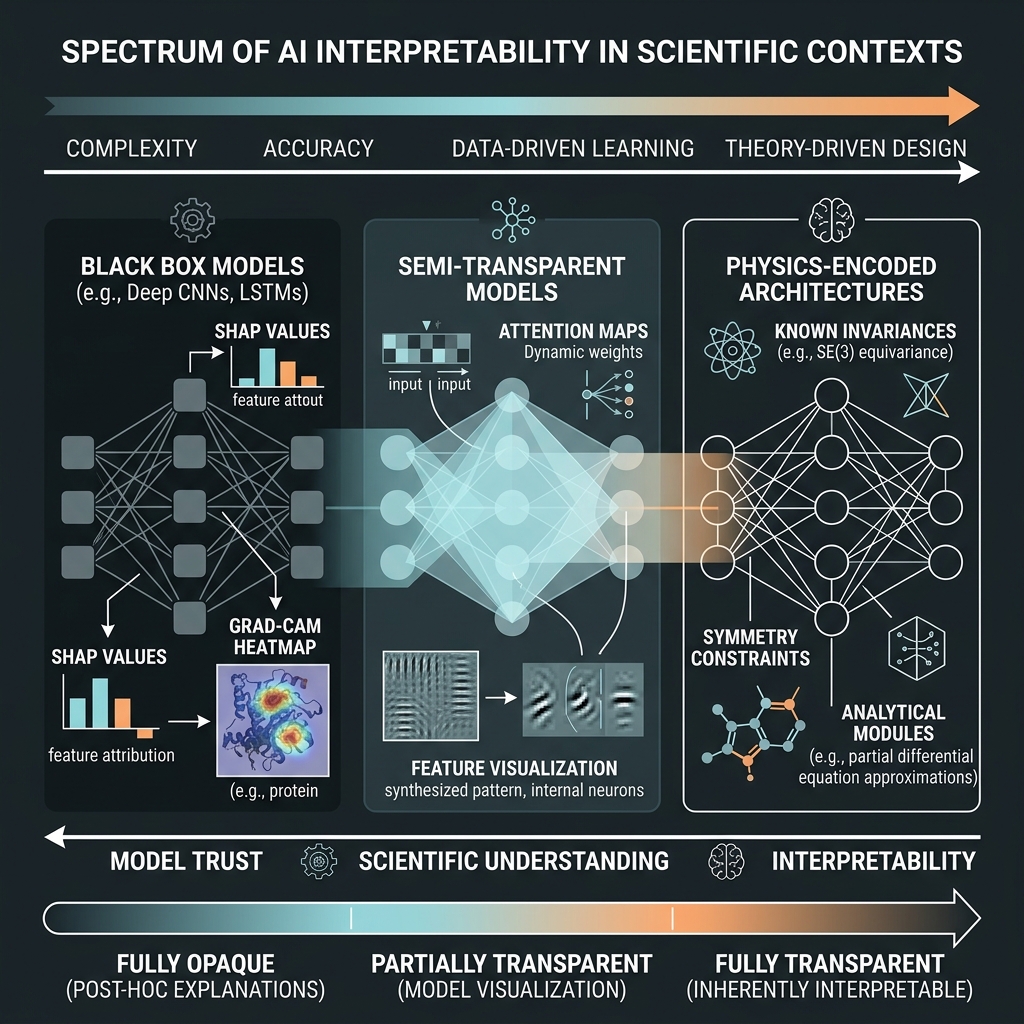
In academic settings, this gap is often addressed with post-hoc explanation tools. Saliency maps highlight which pixels influenced a prediction. SHAP values attribute importance to features. GradCAM overlays heatmaps on images. Attention scores show where a transformer focused.
These methods are useful, but they have well-documented limitations. Saliency maps can be noisy, inconsistent, and sensitive to implementation details. Feature attributions can disagree with each other. Attention does not always correspond to importance in the way intuition suggests [1]. A 2019 study showed that attention weights in NLP models are frequently not reliable indicators of the model's reasoning [2].
For many scientific applications, post-hoc explanations are better than nothing, but they are not the same as built-in transparency.
The distinction matters. A post-hoc explanation tries to reverse-engineer what a model did after the fact. A transparent model is designed so that its internal operations correspond to meaningful, verifiable steps. One tells a plausible story. The other has a known structure.
Why science needs more than a heatmap
In a scientific workflow, the question is rarely just "what did the model predict?" The questions that matter are harder.
Is the model responding to the biological signal or the staining artefact? Is it sensitive to the optical transfer function of this specific microscope? Would it give the same answer if the sample were rotated, translated, or imaged on a different instrument? Is the confidence score calibrated, or is the model simply outputting high probabilities for everything it has seen before? Does the model understand that this measurement has a known noise profile, and is it accounting for it?
A heatmap that says "the model looked at this region" does not answer any of these questions. It tells you where the model looked, not whether it understood what it was looking at.
This is the gap that physics-informed architectures are designed to close.
Physics as interpretability
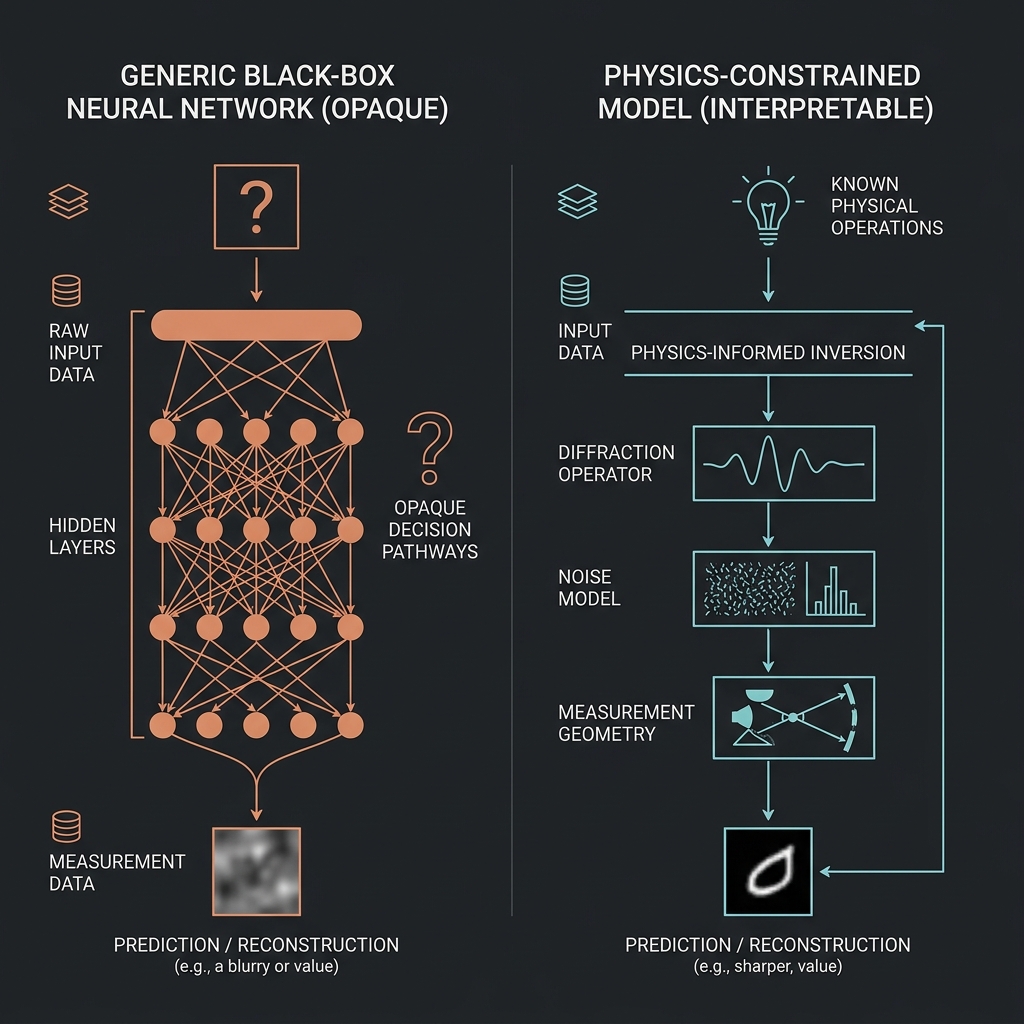
When we say "physics-informed," we do not mean adding a physics loss term as a regularizer on top of an otherwise generic network. We mean encoding the structure of the physical measurement into the architecture itself.
If the imaging system has a known point spread function, that function can be part of the model. If biological objects should be rotationally invariant, the architecture can guarantee that mathematically rather than hoping the model learns it from augmented data. If the noise follows a Poisson or Gaussian distribution, the likelihood function can reflect that directly.
Each of these choices makes the model more constrained, but that is the point. A constrained model has fewer ways to learn the wrong thing. And because the constraints correspond to real physics, the model's behavior becomes interpretable by design.
You do not need to ask a post-hoc tool "why did the model make this prediction?" You can trace the answer through operations that correspond to diffraction, noise, measurement geometry, and known invariances.
This is not a theoretical argument. Physics-informed neural networks have been applied successfully across scientific domains. In computational physics, PINNs (physics-informed neural networks) embed governing equations directly into the loss function and have been used for solving forward and inverse problems in fluid dynamics, heat transfer, and materials science [3]. In microscopy, architectures that encode optical transfer functions and rotational equivariance have been shown to achieve strong performance with dramatically less training data [4].
The interpretability comes for free, because the model is built from components that a domain expert can inspect and understand.
Regulation will force the issue
Even if the scientific argument alone were not enough, regulation is moving in the same direction.
The EU AI Act, which entered into force in 2024, explicitly addresses transparency requirements for high-risk AI systems. Systems used in critical infrastructure, medical devices, and safety-critical industrial processes must meet specific requirements around explainability, documentation, and human oversight [5].
The FDA has also been increasingly focused on AI/ML-based software as a medical device, publishing frameworks for how AI models should be evaluated, validated, and monitored in clinical settings. A key theme in FDA guidance is the need for manufacturers to characterize their models well enough to understand when and how they might fail [6].
For companies developing AI for pharmaceutical screening, medical imaging, or quality control in regulated manufacturing, interpretability is not a research question. It is a compliance question.
A model that cannot explain its outputs in a way that satisfies regulatory review is a model that cannot ship.
The cost of interpretability is lower than people think
There is a common assumption that interpretability requires sacrificing performance. That you must choose between a powerful black box and a weak but understandable model.
That tradeoff was more true a decade ago than it is today.
Modern physics-informed architectures do not simply reduce the model's capacity. They replace generic capacity with structured capacity. A rotationally equivariant convolutional network does not have fewer parameters because it is weaker. It has fewer parameters because it does not waste capacity learning a symmetry that could have been guaranteed. The result is often a model that is both more interpretable and more data-efficient.
Self-supervised learning follows a similar logic. When a model learns meaningful representations from unlabeled data using physically motivated pretext tasks, the resulting embedding space often has more structure and is more interpretable than one learned from supervised labels alone. Features cluster by physical properties. Outliers separate naturally. Anomalies become visible in the representation without needing an explicit anomaly detector.
The cost of interpretability is not performance. It is design effort. Building a physics-informed model requires understanding the measurement. Building a generic model requires only data. But the upfront investment in understanding the physics pays off across the entire lifecycle: less training data needed, faster validation, easier debugging, simpler regulatory documentation, and a model that experts can actually trust.
What this means in practice
For teams deploying AI in laboratories and industrial workflows, the practical takeaway is straightforward.
If your model is a black box, you will spend more time explaining it, more time validating it, more time debugging it when it fails, and more time convincing regulators, quality teams, and domain experts that it can be trusted.
If your model is transparent by design, those costs go down. Not to zero-validation is always necessary-but the validation becomes tractable because the model's behavior can be traced through known operations.
At IFLAI, this is why we build physics-informed architectures rather than relying on generic pretrained networks. Not because generic networks are useless, but because in scientific and regulated deployments, the ability to show your work is not optional.
The black box was always a temporary state. The instruments are too important, the decisions too consequential, and the regulatory requirements too specific for "trust me, the model works" to be enough.
AI in science needs to show its work. And the models that can will be the ones that get deployed.
References
- [1] Jain & Wallace, "Attention is not Explanation," NAACL (2019)
- [2] Wiegreffe & Pinter, "Attention is not not Explanation," EMNLP (2019)
- [3] Raissi et al., "Physics-informed neural networks," Journal of Computational Physics (2019)
- [4] Pineda et al., "Inductive Biases for Efficient Deep Learning in Microscopy," PhD Thesis (2025)
- [5] European Parliament, "EU Artificial Intelligence Act" (2024)
- [6] FDA, "Artificial Intelligence and Machine Learning in Software as a Medical Device" (2021)