Pushing the Boundaries of Single Molecule Microscopy through Deep Learning
A Unified Theory of Data-Efficient AI
In the biological sciences, researchers often treat microscopy, chemical sensing, and mass spectrometry as entirely separate computational domains. The 2024 PhD Thesis, Pushing the boundaries of single molecule microscopy, optical sensing and mass spectrometry through deep learning, argues against this fragmentation.
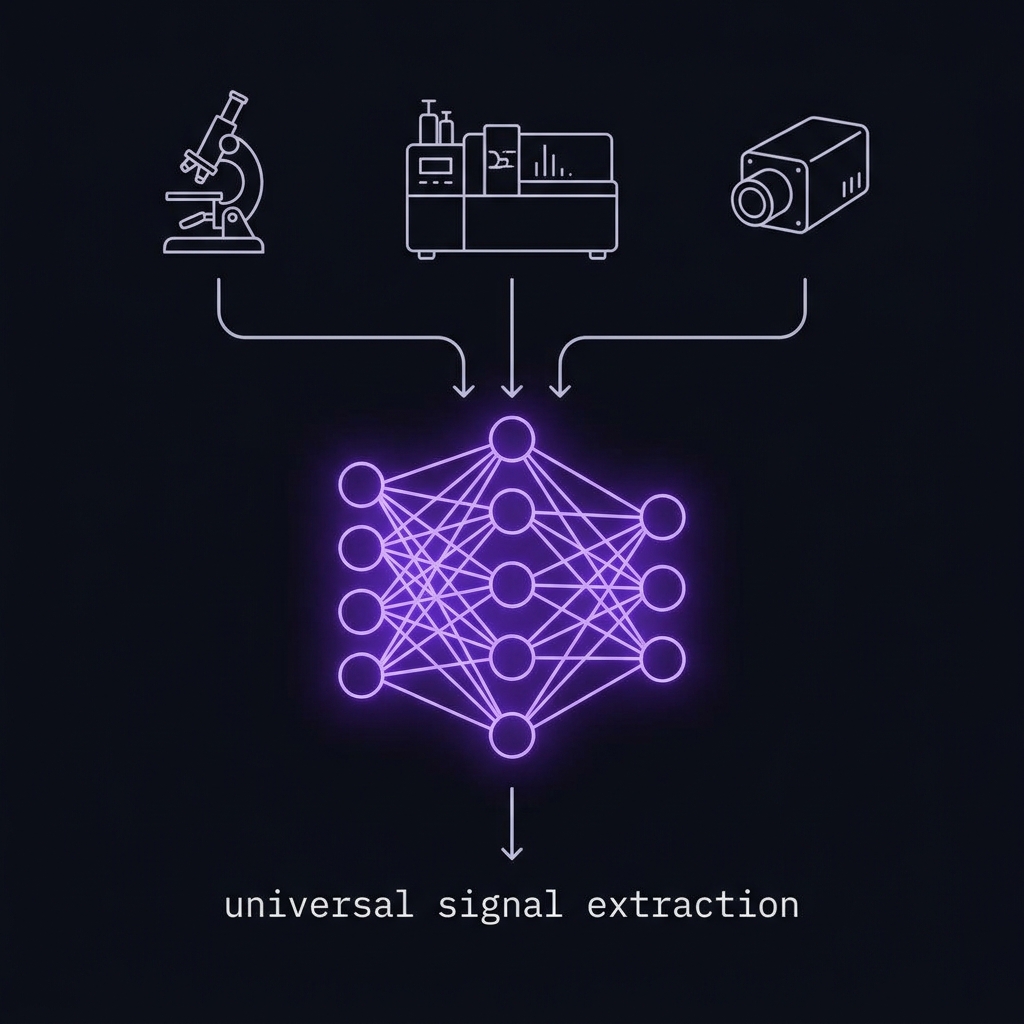
At a fundamental physical level, all of these techniques are dealing with the same problem: extracting a highly specific, weak signal from an overwhelming amount of background noise.
Bridging the Modalities
This thesis demonstrates that the same underlying deep learning architectures, specifically those built on robust physics-informed inductive biases, can be generalized across completely different optical and physical modalities.
Whether the AI is tracking the diffusion of a single fluorophore in a cell membrane, extracting the resonance shift of a plasmonic hydrogen sensor, or denoising the readout of a catalytic mass spectrometer, the mathematical framework remains remarkably consistent.
Key Advances Explored:
- Cross-Disciplinary Algorithms: Proving that temporal convolutional networks and transformers designed for optical microscopy perform exceptionally well in mass spectrometry.
- Signal Denoising: Establishing a universal framework for neural denoising at the extreme physical limit of detection across multiple hardware systems.
- Foundation Model Precursors: Laying the academic groundwork for the development of highly generalized, multi-modal foundation models.
The IFLAI Advantage
This unified approach is why IFLAI is not just a "microscopy AI" company. Because our foundation models understand the underlying physics of signal extraction, we can rapidly deploy our architecture to solve complex detection and tracking problems across manufacturing, security, and advanced chemical sensing.